
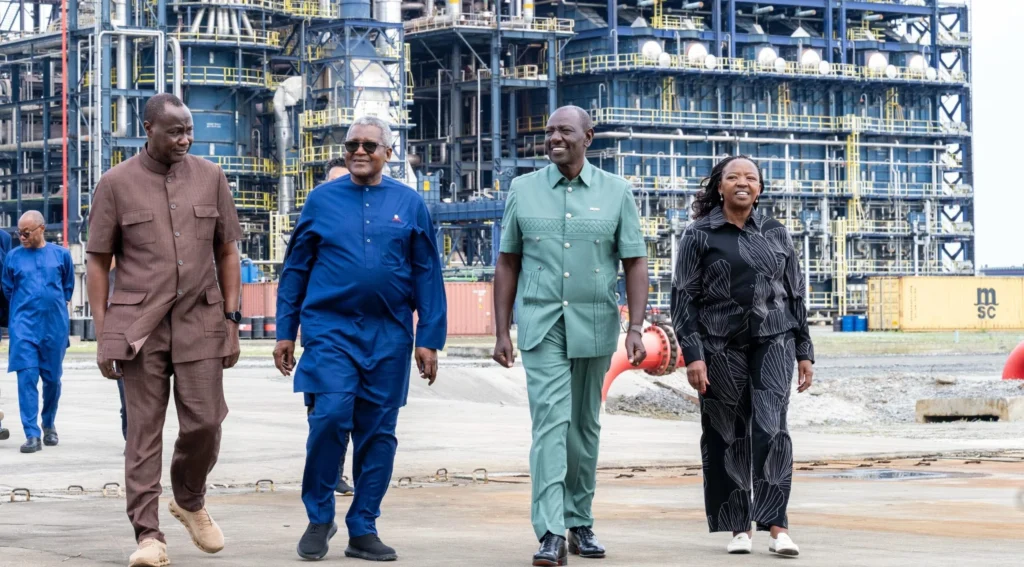

East Africa’s energy landscape is on the brink of a historic transformation. Industrialist Aliko Dangote and the Dangote Group have targeted Lamu, Kenya, as the site for a massive $16–$17 billion greenfield oil refinery.
Designed as the Dangote Group’s largest foreign investment outside Nigeria, this mega-project is set to reshape trade, energy security, and industrial growth across the East African Community (EAC) and the Horn of Africa.
Here is a deep dive into what this project entails, why Lamu was chosen, and what it means for the region.
Key Figures at a Glance
- Investment: $16 to $17 Billion (~Ksh 2 Trillion)
- Processing Capacity: 700,000 barrels of crude oil per day (bpd)
- Output: Over 100 million liters daily of petrol, diesel, jet fuel, polypropylene, and base oil
- Power Generation: 1,000 MW captive power plant (with ~500 MW integrated into Kenya’s national grid)
- Job Creation: Over 60,000 direct and indirect jobs
- Construction Timeline: Projected 3-year buildout following initial groundwork and equipment delivery via the Port of Lamu
Strategic Location: Why Lamu?
While initial discussions explored alternative sites—including Tanga in Tanzania—Lamu emerged as the ideal location for several key reasons:
- Deep-Sea Port Infrastructure: The Port of Lamu offers natural deep-water berths capable of handling large crude carriers and heavy industrial equipment shipments.
- The LAPSSET Anchor: The refinery acts as a central anchor for the Lamu Port-South Sudan-Ethiopia Transport (LAPSSET) corridor, connecting regional trade routes across land and sea.
- Cross-Border Supply Links: Positioned near regional crude sources in Kenya, Uganda, South Sudan, and the Democratic Republic of Congo (DRC), the facility can efficiently refine local resources for export.
Joint Regional Ownership
To ensure broad political and economic alignment, the ownership structure involves both private capital and regional government stakes:
- Dangote Group: 70%
- Government of Kenya: 10%
- Government of Ethiopia: 10%
- Government of Rwanda: 10%
By giving neighboring nations an equity stake, the refinery locks in long-term demand and creates a shared economic interest across East and Central Africa.
Economic Potential & Regional Impact
1. Energy Independence & Price Stability
East African nations historically rely heavily on imported refined petroleum, leaving local markets vulnerable to global supply shocks and high freight costs. Refining crude locally is expected to stabilize fuel prices, reduce import bills, and preserve foreign exchange reserves.
2. Industrial Spin-Offs
Beyond fuels, the refinery’s output of polypropylene and base oils provides raw materials for local manufacturing, plastics, petrochemicals, and lubricant production.
3. Power Grid Boosting
With an integrated 1,000 MW power generation capacity, the plant plans to offload nearly half of its generated electricity back into Kenya’s national grid, providing reliable power to regional industrial zones.
Challenges on the Horizon
Despite the enormous economic potential, a development of this scale brings notable local hurdles:
- Land Acquisition & Displacement: Site clearing and groundwork in areas like Chandavai have raised concerns among local landowners, resulting in legal petitions regarding fair compensation and resettlement rights.
- Environmental Considerations: Community advocate groups and environmental organizations are keeping a close watch on marine ecosystem protection around the Lamu archipelago, emphasizing the need for strict environmental management throughout construction and operation.
Looking Ahead
The Dangote Lamu Refinery represents one of the largest infrastructure investments in East Africa’s history. If successfully executed, it has the potential to turn Lamu into a major energy processing hub, altering trade routes across eight neighboring countries and powering the region’s industrial future.